

Tiny but Mighty
A Microforest Grows in Middletown, CT

“Let’s all work together to create hometown forests made of hometown trees…that will protect life.” – Miyawaki Akira, Forests for the Future
The volunteer tree planting on November 8, 2025, is memorable for Moody Elementary School, the Middletown Urban Forestry Commission, and the community living in central CT.
Sunny morning rays warmed the freshly turned soil in holes spaced five feet apart in a corner of the school’s grassy field.
“We planted in early November 2025. While that’s late in the Fall planting season, it should still allow the plants to settle in before the ground freezes, especially the deciduous species, as their roots don’t need to support foliage over the winter.” Steve Cronkite, Chair of Middletown’s Urban Forestry, explains.
He emailed answers to my questions, with the commission’s tree layout chart and event photos, after my volunteer planting experience.
When I first arrived at Moody’s planting site, Steve pointed to materials on the subject of Microforests next to the volunteer sign-in sheet. A New York Times article from 2023 lay beside a bright green, eye-catching young forest photo printed on a paperback by Hannah Lewis, Mini-Forest Revolution – Using the Miyawaki Method to Rapidly Rewild the World.
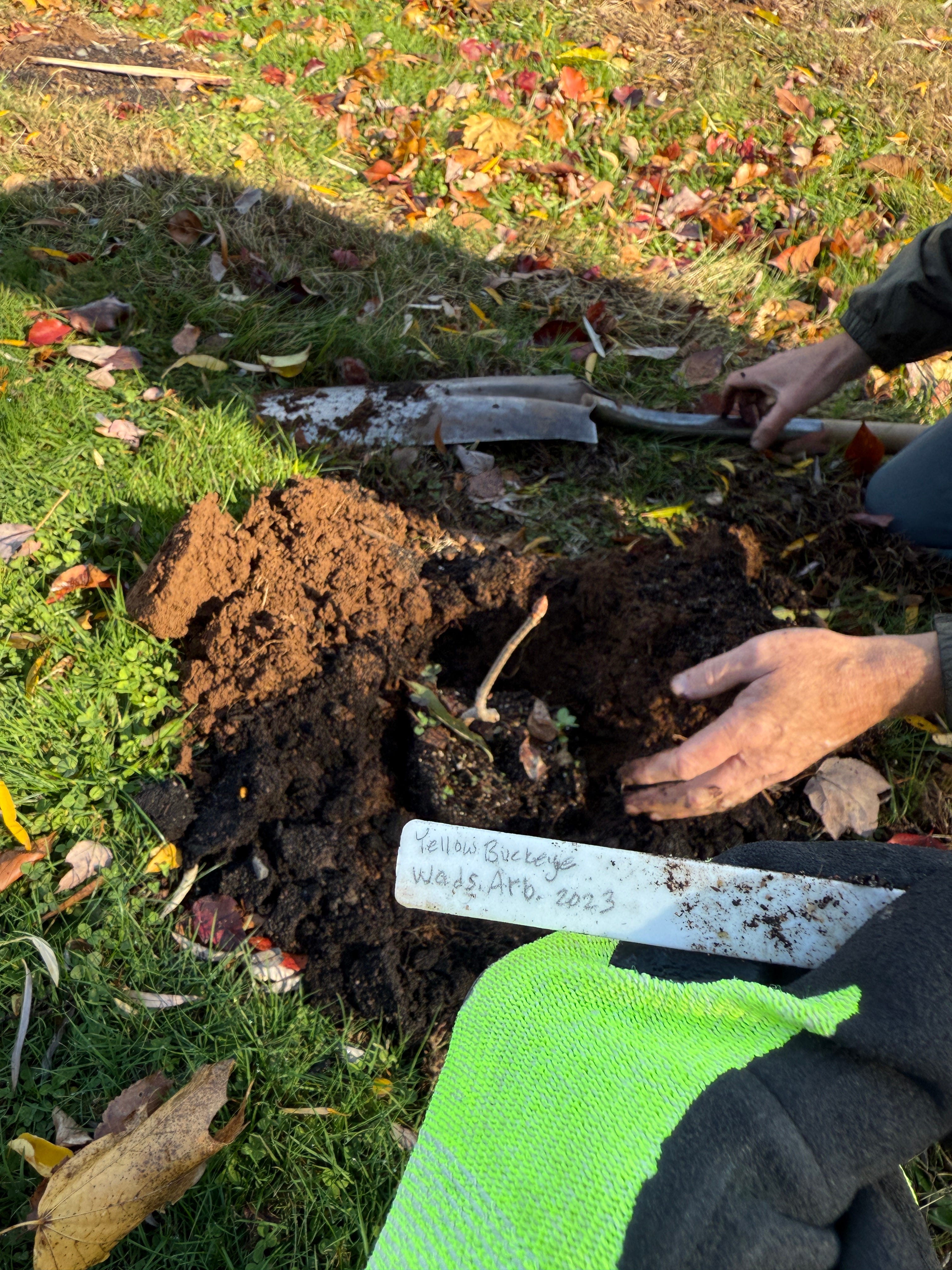
Steve and his partner, Paul, led the morning tree planting, answering volunteer questions about the native saplings and the method, mysterious and new until explained.
“Will the trees actually grow so close together?” A nearby volunteer was asking while I was digging a hole for my first native tree, a Pignut hickory, or in Latin, Carya glabra.
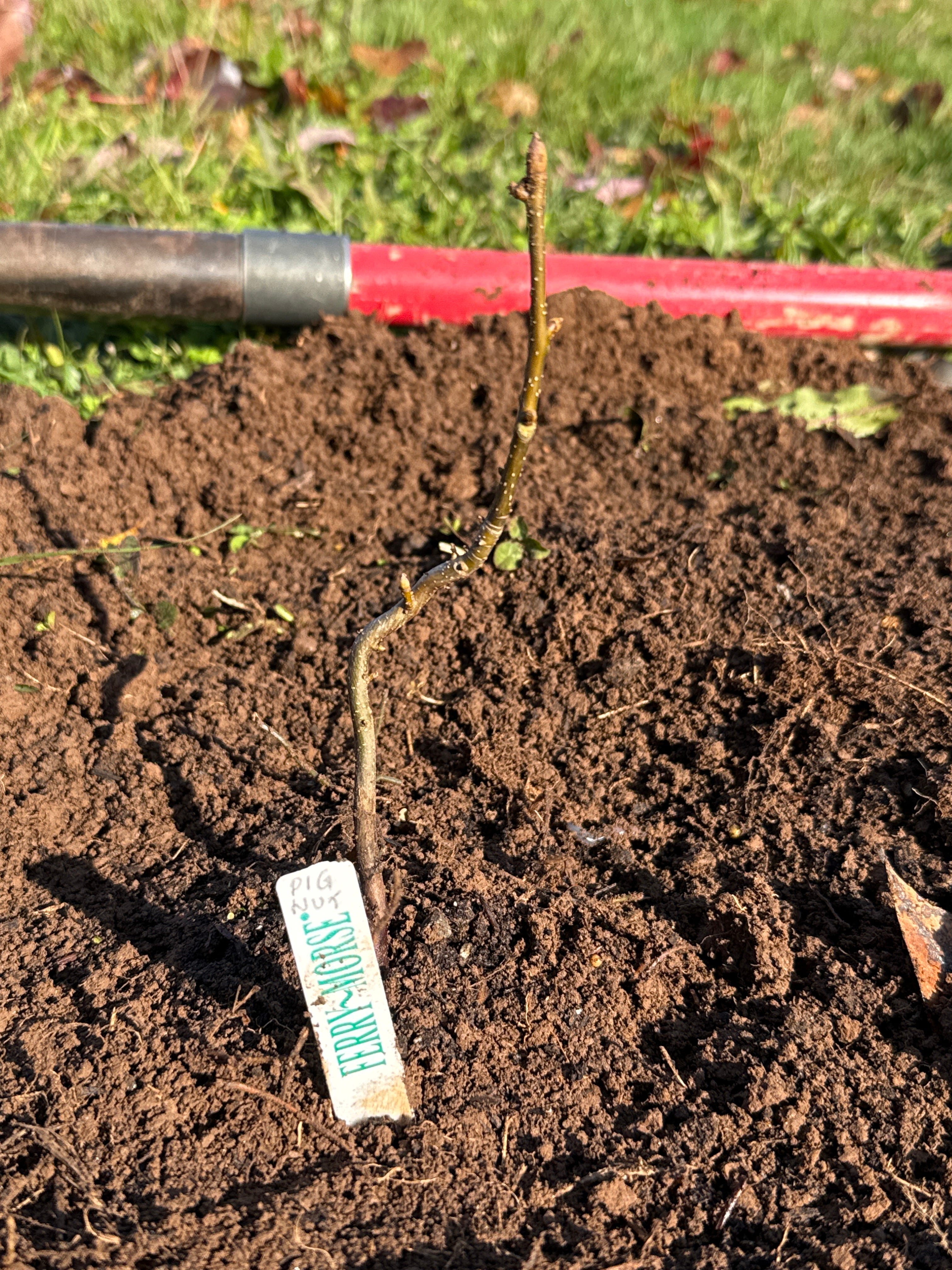
I was genuinely curious as well – deciding to find out more. The Miyawaki Method, a term coined by former Japanese plant ecologist Dr. Akira Miyawaki, is a global movement.
Communities are afforesting in degraded areas prone to extreme weather like flooding to build soil for drainage, to lower hot city air temperatures, to attract diverse wildlife, and so much more.
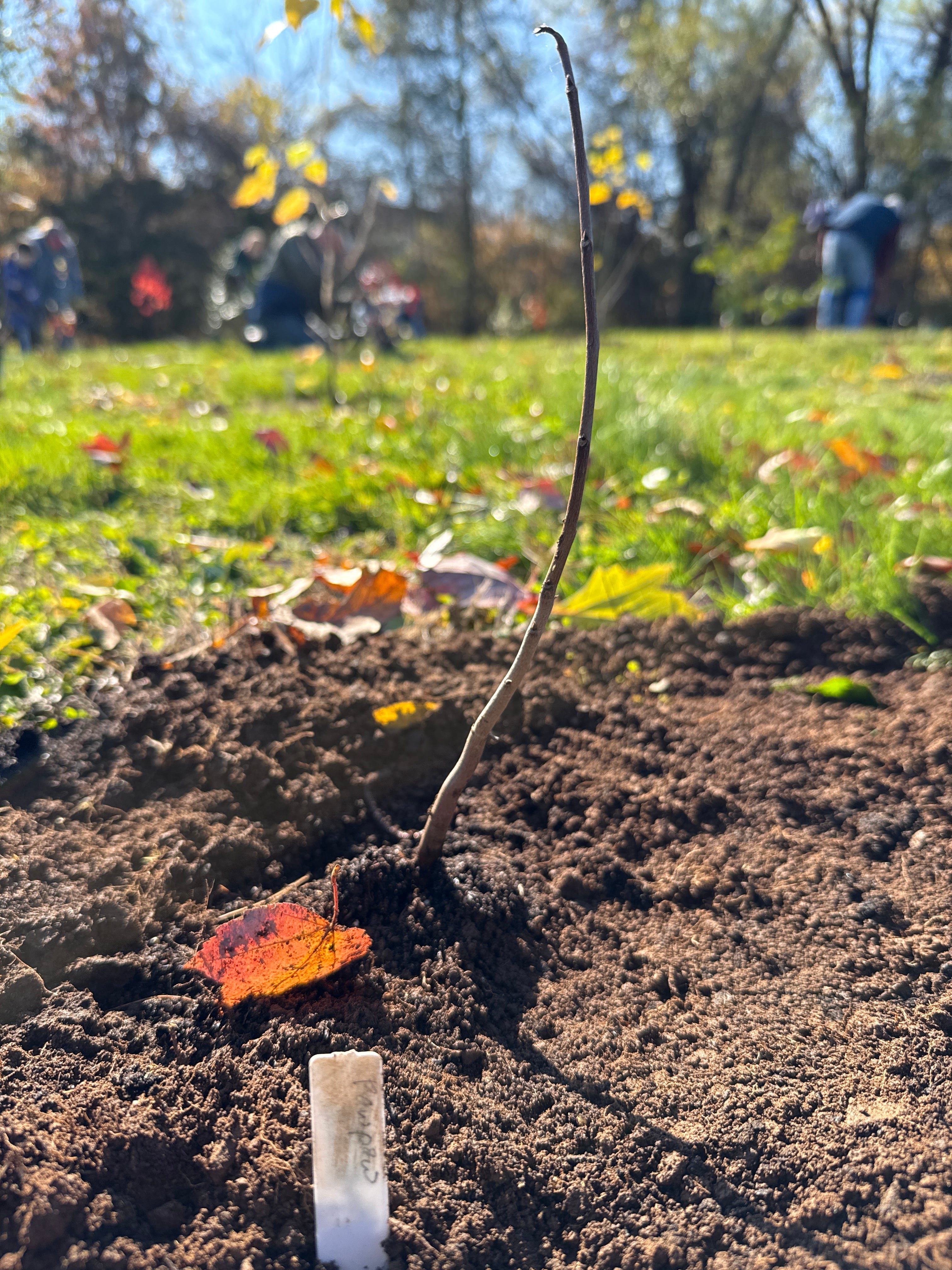
Dr. Miyawaki planted over 40 million trees well into his 80s, believing in the “power of the forest.” At the time of writing his book, Forests for the Future, his current community commitment was to reforest the areas affected by the 2011 Great East Japan Tsunami and Earthquake. The Miyawaki movement is taking root at more reported sites in the US.
“In late 2024, my husband, Paul, suggested the Moody Elementary School site, which [commission member] Jane and I agreed looked promising. It is City-owned, easily accessible, presents educational opportunities for local school students, and has good soils (confirmed by soil tests). We presented the proposal to the Board of Education’s Facilities Committee, and they approved it on condition that the trees would be ID labeled and a photographic record would be kept. The Moody school’s principal and grounds staff were also supportive.” Steve writes.
The microforest planted in Moody’s schoolyard is a blend of native trees, shrubs, and herbs to create the layers of a tiny forest ecosystem – growing in decades, not centuries. The forest’s rapid growth spurt ignites when trees compete for light. The plants are growing faster because they are so close together!
Multiple donations from different sources made this project possible.
“About a dozen were left over from a donation of saplings that Eversource provided for an Earth Day giveaway. Several more were donated by volunteers on the day of planting. Many were seedlings I’d been growing from seeds for the past two years, which I had collected specifically for the microforest project, while others were seedlings I had been growing just for fun.” Steve writes.
You can view the complete plant list in this document, courtesy of the Middletown Urban Forestry Commission.
Microforest Plant List- English and Latin

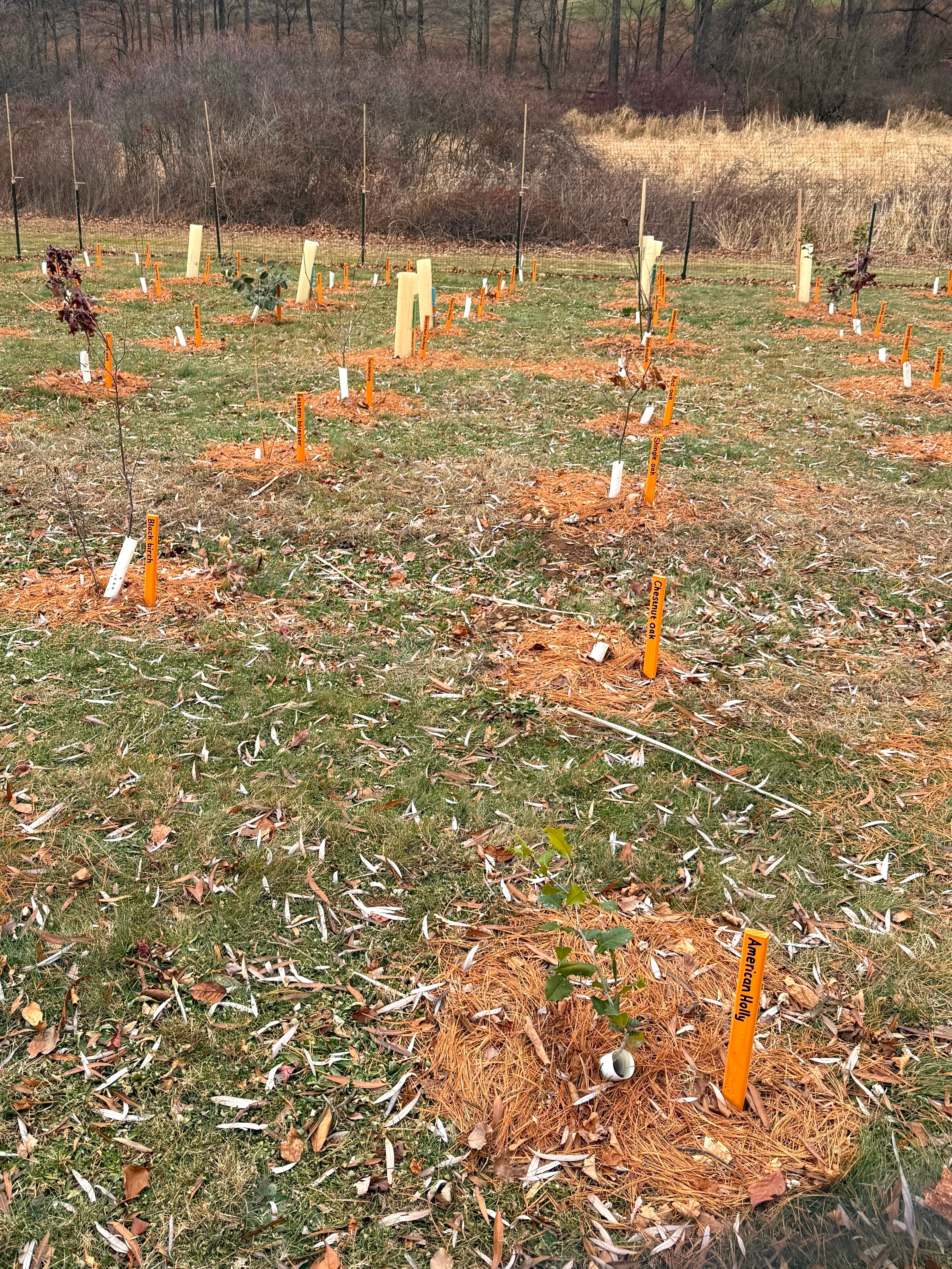
A month later, in cloudy December, I visited the empty school grounds to see the site over the weekend. I recalled back in November, the square postage-stamp site was dotted with 100 fresh holes of turned soil to mark the spaces for us volunteers to plant out the grid design.
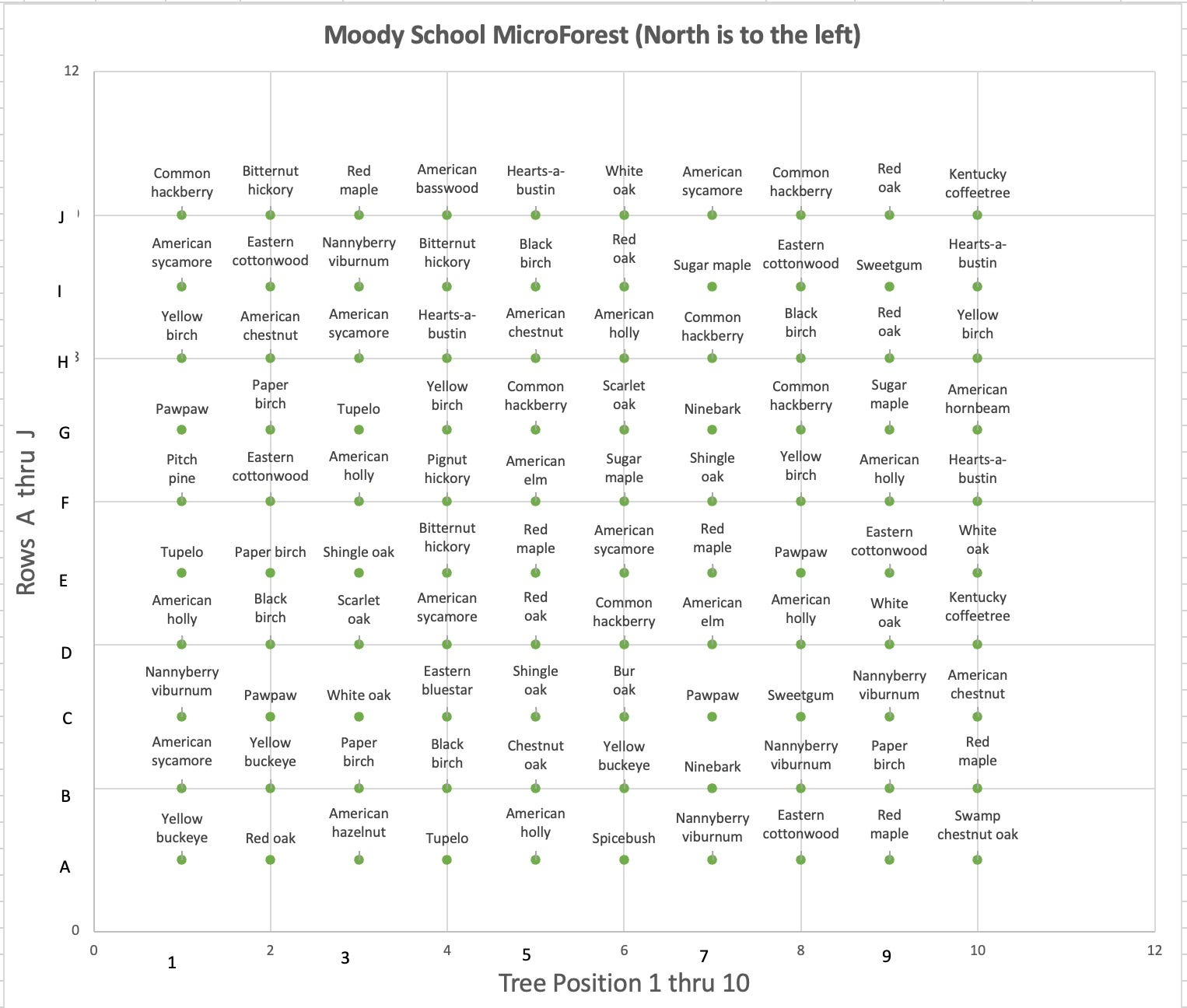
“The microforest is small - only about 50’ x 50’. Its 100 trees & shrubs, representing over 30 native species, are planted 5 feet on center, in a square 10-tree by 10-tree grid pattern. The pattern will look artificial at first, but it allows keeping track of the individual trees more easily than if they were planted in a random pattern.”
Steve kindly shared this chart after the event.
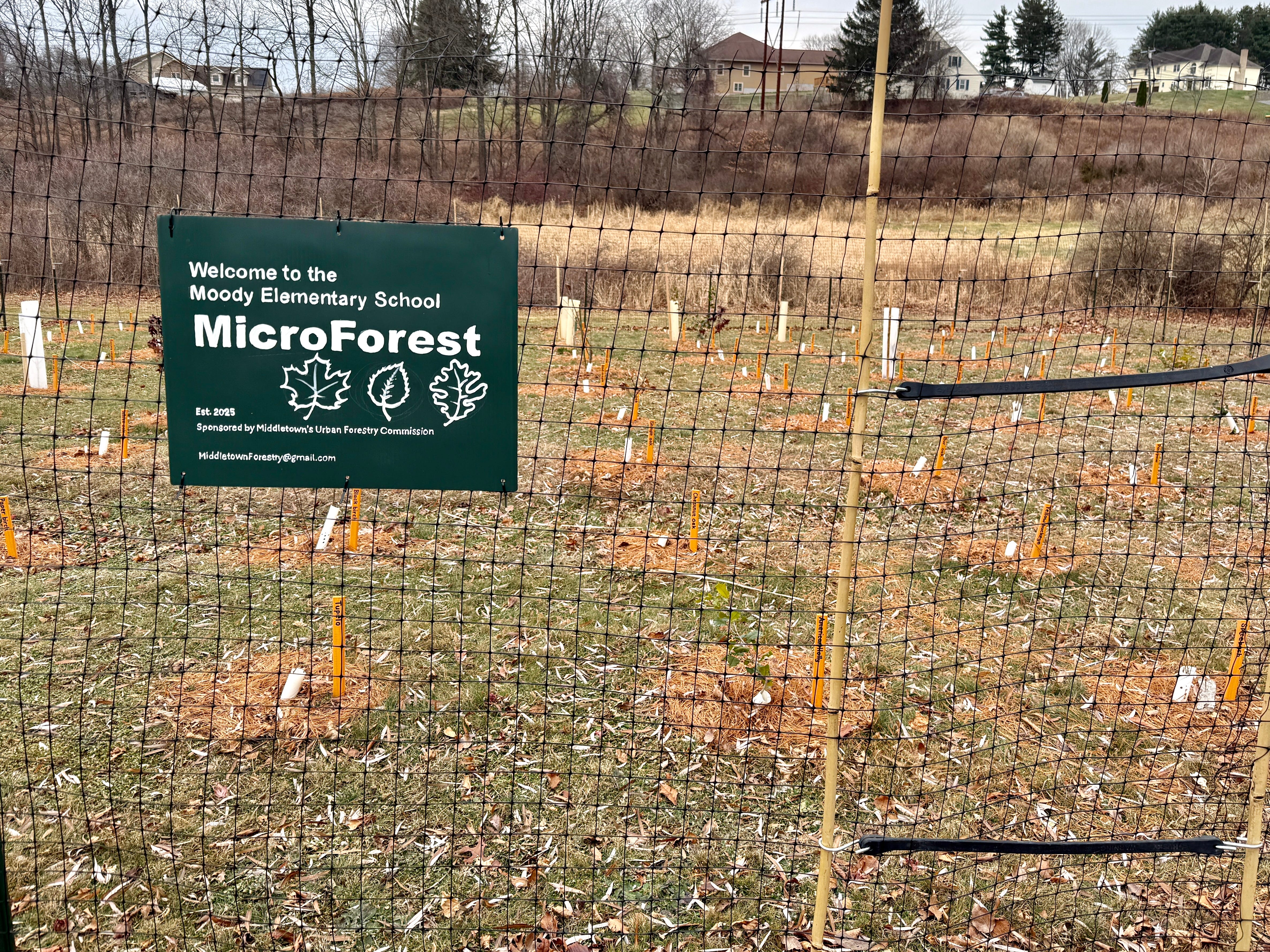
The 6-foot deer fence came up over my head – relatively short but a substantial deterrent. The labeled saplings, mostly dormant twigs, were protected with a white casing around the tree base with a ground layer of pine mulch. “I hope it will still dissuade deer because there is such a small area inside the fence, and there are other woodlands to browse on nearby,” Steve adds.
In response to my question, “Why plant this here and now?” The Chair of the Middletown Urban Forestry Commission, Steve, shared his closing thoughts.
“Moving forward, my hope for the microforest is twofold. First, it will serve in the next few years as an example of afforestation, one tiny pixel on a satellite image that will be transformed from ‘developed’ to ‘forested’, a gain within a tide of forest loss. Second, I hope that Moody School visitors and students will become acquainted with our native tree and shrub species, come to appreciate these gifts of nature, take time to focus on the natural world, and become invested in it.”
It takes a community of volunteers and homegrown tree donations to start your own microforest. Where do you see tree plantings in your community? Who are the organizers? Do they know how small changes to our planting method and forest design speed up the process by decades?
Comment below with your tree planting experiences, and please share this so more of us can plant forests for our future. I can’t wait to revisit this microforest to observe what happens in five, ten, and twenty years!
Acknowledgements:
Special thanks to Steve Cronkite for his expertise in dendrology and willingness to share insights and resources about the Microforest project.
Extended learning:
Follow the commission leading the microforest project by reading their minutes:
The RockFall Foundation Symposium Presentation Materials- Trees in a Changing Connecticut
Audio:
Books to read:
Forests for the Future by Dr. Akira Miyawaki
Mini-Forest Revolution – Using the Miyawaki Method to Rapidly Rewild the World by Hannah Lewis
A wonderful post - utterly fascinating! I learned a new word (afforestation!). And the Japanese man who planted 40 million trees- WOW!! 🤯 How wonderful to see his legacy live on with these micro forests. The idea that these trees and shrubs will actually grow faster because of resource competition was also intriguing. I hope you’ll revisit the site in the future to update us? 🙏🏻
Cheers for this attempt at afforestation! It will be so great to see in a few years all of the benefits that this act of giving back will bring to the land. Appreciative of the group of folks involved in this effort.